

What CPUC ordered and why it is different this time
The order in plain terms
On February 26, 2026, in IRP proceeding R.25-06-019, the CPUC approved a decision that requires CPUC-jurisdictional load-serving entities (LSEs)—IOUs, CCAs, and ESPs—to procure additional clean resources for 2030–2032 reliability, while simultaneously transmitting updated base and sensitivity portfolios to CAISO for its 2026–2027 Transmission Planning Process (TPP). [7]
Key procurement elements that matter to customers:
The decision requires LSEs to procure 6,000 MW NQC total, delivered as 2,000 MW NQC by June 1, 2030, +2,000 MW by June 1, 2031, and +2,000 MW by June 1, 2032. [8]
Eligible resources must be non-emitting, storage, and/or Renewables Portfolio Standard (RPS)-eligible; fossil generation cannot be used to satisfy the obligation. [9]
At least one-quarter of each LSE’s obligation (collectively 1,500 MW NQC) must come from clean firm and/or long-duration storage by June 1, 2032. Clean firm is defined (via prior decisions) as ≥80% capacity factor and not use-limited, and long-duration storage is defined as 8+ hours at maximum capacity. [10]
The CPUC requires contract tenors of at least 10 years for resources counted toward this order—an important detail for long-term bill impacts and risk allocation in contracts. [11]
Capacity accreditation for compliance is explicitly tied to marginal ELCC studies: the CPUC plans to publish compliance ELCCs for 2030/2031 by July 31, 2026, and for 2032 by December 31, 2027. [12]
The order imports the prior “good faith” and enforcement architecture (including potential penalties and “backstop procurement”), and applies flexible compliance provisions if resources are under contract but delayed, consistent with prior procurement frameworks. [13]
The decision also flags rate-structure implications: IOU procurement under this order is subject to Power Charge Indifference Adjustment (PCIA) vintage treatment tied to the effective date, with related IOU advice letter actions. [14]
What is “new” or “different” in the framing
Load-growth as the central driver, not a generic decarbonization add-on
The CPUC explicitly grounds the procurement in the need to maintain reliability “consistent with forecasted demand growth.” [15] This is not rhetorical: allocation is based on load-forecast-driven metrics (managed peak contribution) rather than a flat statewide target. [16]
Why this matters: California institutions are now treating large-load growth as an operational planning reality. CAISO states that the CEC forecast expects data center load in the CAISO balancing area to increase by 1.8 GW by 2030 and 4.9 GW by 2040, and frames large loads (data centers, EV charging, industrial electrification) as drivers of material planning changes. [17]
Timing explicitly linked to federal incentives, and to evolving federal-policy risk
The decision states the procurement is intended (in part) to “pursue any viable projects that can still qualify for Federal tax credits or other incentives,” and the order directs attention to incentive timing as a real system-planning constraint. [18]
Notably, CPUC modeling assumptions in the decision explicitly incorporate federal-policy changes and assume wind and solar tax credits end for projects that fail to commence construction by July 4, 2026, while energy storage and clean-firm technologies retain eligibility through 2032 (with safe-harbor and phase-out concepts referenced). [19] This is a meaningful shift in how procurement urgency can be justified: the state is effectively signaling “build now or lose federal leverage,” especially for wind and solar under those assumed conditions. [20]
Portfolio guardrails aimed at “attributes,” not technology slogans
The 25% clean-firm / long-duration storage requirement mirrors an earlier lesson of California reliability planning: at high levels of solar and 4-hour storage, the system increasingly needs resources that can support reliability beyond narrow evening ramps. [21]
Importantly, the CPUC considered but ultimately removed a cap on storage that was in the proposed decision, explicitly stating it did not want to discourage longer-duration storage beyond 4-hour lithium-ion. [22] This is a subtle but important differentiator: rather than limiting storage volume, the decision pushes the market toward duration and firmness attributes by requiring a floor for LDES/clean firm. [23]
Transmission integration is not just a side memo; it is operationalized
The decision is explicitly bifurcated into “Power Supply” (procurement) and “Power Delivery” (transmission planning), with portfolios transmitted to CAISO for the 2026–2027 TPP. [24] This is aligned with the CPUC–CEC–CAISO 2022 Memorandum of Understanding (MOU) intended to tighten linkages among demand forecasting, resource portfolios, interconnection, procurement, and transmission planning. [25]
The fact sheet underscores that the 2026–2027 base case portfolio looks 15 years ahead and uses the CEC 2024 IEPR forecast, is larger than the prior year’s base case to account for higher load, and includes flexibility for offshore-wind timing (including asking CAISO to allow Humboldt transmission in-service dates to extend to June 1, 2036). [26]
Historical context and the demand outlook behind the order
California has been in “catch-up” procurement mode since the early 2020s
The February 2026 procurement order is best seen as the next step in a multi-cycle procurement trajectory—not an isolated event.
In D.21-06-035 (Mid-Term Reliability, 2021) the CPUC ordered 11,500 MW of new NQC to come online in 2023–2026, driven by reliability concerns, extreme weather risk, and replacement needs for retiring gas units and Diablo Canyon’s planned retirement. [27] Of that 11,500 MW, at least 2,000 MW was required from “long lead-time” resources, including 1,000 MW of long-duration storage (8+ hours) and 1,000 MW of clean firm resources. [27]
In D.23-02-040 (Supplemental MTR, 2023) the CPUC ordered an additional 4,000 MW NQC for 2026–2027, citing updated load forecasting suggesting higher demand, accelerating climate impacts, potential additional fossil retirements not anticipated in 2021, and the likelihood that long lead-time procurements would be delayed beyond 2026. [28]
The February 2026 order explicitly characterizes itself as continuing the “momentum of annual procurement activity” begun under these earlier MTR decisions. [29]
The demand outlook is no longer “flat load with incremental electrification”
Two planning inputs are especially consequential for interpreting the 6 GW decision:
The CPUC’s own 2026–2027 TPP analysis materials show that managed load grows by 157 TWh from 2024 to 2040, with ~80% driven by EVs, building electrification, and data centers, and that by 2040 EVs can represent 23% of total managed load, followed by building electrification (10%) and data centers (8%). [30]
CAISO’s 2026 issue paper frames large-load growth as a core system issue and cites the CEC’s forecast that data center load within CAISO grows 1.8 GW by 2030 and 4.9 GW by 2040, alongside broader electrification loads. [31]
The CEC’s data center forecast work is itself becoming more operationally relevant: CEC staff note plans to disaggregate data center load impacts to busbar to support CAISO transmission planning (a sign that “where load shows up” is becoming as important as “how much load”). [32]
Transmission planning is reacting to load growth, with long lead times baked in
Even before the February 2026 CPUC order, CAISO’s Board-approved 2024–2025 Transmission Plan states that load forecasts associated with building electrification, data center growth, and transportation electrification drive “significant reliability-driven needs,” including an increase in the year-over-year rate of peak demand growth from 0.99% to 1.53% (and in the Greater Bay Area from 1.22% to 2.14%, a >2,000 MW increase in the 2035 peak forecast versus the previous cycle). [33]
CAISO also emphasizes that recommended transmission projects are phased over lead times of up to eight to 10 years, underscoring why “procurement now for 2030–2032” is not necessarily early in California infrastructure terms. [33]
Technical implications that matter to customers
Capacity value is being operationalized through NQC and marginal ELCC
The order is measured in NQC, not nameplate MW, and explicitly ties compliance to marginal ELCC studies scheduled for publication in 2026 and 2027. [34] This matters because marginal ELCC is designed to represent the incremental reliability value of new additions to a system that already contains substantial renewables and storage. [35]
This choice has real portfolio consequences:
The CPUC’s marginal ELCC work used for filing requirements indicates that solar marginal ELCCs remain low across modeled years, while firm resource ELCCs are generally stable at ~85–90%, and storage ELCCs—high in the near term—can decline as storage saturates and critical hours spread. [36]
NREL’s synthesis of capacity-credit practice highlights why this is happening: ELCC (especially marginal ELCC) is meant to quantify the fraction of nameplate capacity that can be relied upon during critical periods, and marginal ELCC can decline as penetration increases—solar is a commonly cited example. [37]
A practical translation for customers: a megawatt is no longer a megawatt. Contracts and investments that only optimize for annual MWh or renewable branding can underperform on reliability value, especially in late-day and seasonal stress conditions.
Storage duration tradeoffs are becoming a system-planning issue, not just a project-design choice
The CPUC’s clean-firm / long-duration requirement is a direct response to an evolving reliability picture where the system’s “critical hours” can expand across both hours and seasons over time. [38] In CPUC modeling, even very long storage (e.g., 100-hour) can see declining marginal ELCC in certain future years due to multi-day energy constraints, charging constraints, and efficiency limitations—suggesting that duration alone is not a silver bullet if the system becomes broadly energy constrained. [36]
This is why the decision avoids a simplistic “cap storage” approach and instead sets an attribute floor while avoiding deterrence of longer-duration designs. [39]
Deliverability and transmission are inseparable from resource procurement
For customers, the “capacity” you pay for only protects you if it can be delivered where and when needed.
The CPUC explicitly transmits portfolios to CAISO for the 2026–2027 TPP, and the decision finds it reasonable to ask CAISO to reserve deliverability for resource categories like geothermal, LDES, out-of-state wind, and offshore wind. [13]
CAISO describes the tight coupling between CPUC portfolios, the CEC forecast, and CAISO transmission planning; it also notes that if a large-load interconnection request arrives after the demand forecast and portfolios are set, transmission owners may submit proposals into the TPP for ISO concurrence, focused on the transmission component of the interconnection. [5]
From a project-risk standpoint, CAISO’s own transmission plan makes clear that many transmission solutions have multi-year lead times (8–10 years for some projects). [33] This duration mismatch—fast-moving load growth versus slow-moving wires—drives a material portion of the “execution risk” customers will experience.
The order preserves regulatory flexibility—useful for the system, but a source of uncertainty for customers
The decision states that resources used for compliance must meet RA eligibility requirements in place at the time they are counted, effectively allowing future RA rule changes to flow through to this procurement order. [16]
This may be prudent system governance, but it is a real contract risk for customers and developers: a resource that looks “compliant” today may see its accredited capacity value or eligibility conditions change later, affecting economics and hedge performance.
Customer risk exposure and the “too little, too late” question
Rate impacts: more than “yes/no,” less than “the order drives everything”
The CPUC argues that planning ahead helps avoid expensive emergency actions and aligns procurement with transmission investments to avoid costly mismatches. [40] Those are credible benefits if the procurement is executed efficiently and if transmission keeps pace.
However, California rate trends are being driven by multiple large forces beyond this single order. The Legislative Analyst’s Office (LAO) reports that California’s residential electricity rates are among the highest in the U.S., and that from 2019–2023 average residential electricity rates rose about 47% statewide (with IOU increases ~48%–67%), driven by factors including wildfire-related costs and decarbonization investments; the LAO also flags growing demand and increasing climate-policy stringency as emerging rate drivers. [41]
For C&I customers, the key implication is: the order may modestly reduce the probability of acute reliability-driven cost spikes (e.g., emergency procurement), but it is unlikely to “shield” customers from rate increases altogether, given the broader cost stack (transmission investment, wildfire mitigation, system modernization, and the costs of firming a higher-renewables grid). [42]
Execution and delivery risk: customers ultimately pay for plans that do not always materialize
The decision itself recognizes stakeholder debate that procurement orders can burden ratepayers, interact with uncertain forecasts, and affect negotiating leverage. [43] It also embeds “good faith” and flexible compliance mechanics (and potential backstop procurement with cost responsibility allocated to customers of non-compliant LSEs), implicitly acknowledging that procurement and delivery risk is not hypothetical. [13]
From a customer-risk lens, this manifests in several ways:
Portfolio underperformance risk. If the market over-deploys resources that look “cheap per MW nameplate” but have low marginal ELCC, the system could still experience tightness in critical hours—even while large amounts of renewable energy are produced and curtailed at other times. The structure of the order (NQC/mELCC) attempts to manage this, but it cannot eliminate it. [2]
Local reliability and deliverability risk. System-wide procurement does not automatically produce capacity in constrained local areas, and transmission timelines can be long. CAISO highlights that forecasting, portfolios, and transmission approvals are coordinated, but significant upgrades remain necessary, with some projects requiring many years to complete. [44]
Regulatory-change risk. Because compliance depends on evolving RA eligibility and future ELCC studies, customers bear the risk that what “counts” today may shift, affecting contract value and cost recovery. [16]
Cost-allocation and “who pays” risk is becoming more explicit under large-load growth
For large-load businesses, the most strategically important risk may be cost allocation—especially transmission-level interconnection and “make-ready” infrastructure.
CAISO notes that load interconnections are led by utilities, and highlights PG&E’s proposed Electric Rule 30 for transmission-level retail customers; critically, CAISO states the CPUC approved interim implementation with the caveat that customers interconnecting under Rule 30 would cover full initial infrastructure costs while the CPUC evaluates cost causation and allocation. [5] CAISO further notes that differentiated service offerings (including non-firm/curtailable approaches) could accelerate interconnection timelines, but require careful operational and planning integration. [45]
Separately, the February 2026 procurement decision explicitly addresses that IOU procurement under this order will receive PCIA vintage treatment based on the effective date—an important consideration for customers evaluating CCA/direct access pathways and long-term departing-load cost exposure. [14]
Is it “too little, too late”?
The honest answer is: it is sized to one modeled need case, but California is managing a range of plausible futures.
In the procurement-need analysis reflected in the decision, the base scenario shows a planning capacity (PCAP) shortfall rising to roughly 2,300 MW (2030), 4,000 MW (2031), and 5,900 MW (2032); under an “increased data center load” sensitivity, the need modestly rises to about 2,544 MW (2030), 4,306 MW (2031), and 6,295 MW (2032)—which would exceed the ordered 6,000 MW by roughly 295 MW by 2032 in that sensitivity case. [46]
This is the critical nuance: the order is not obviously “too small” based on the base case, but it could be tight if load growth (including data centers) lands high, or if delivery risk causes slippage. [47]
Also, it is not designed to solve near-term (2026–2028) constraints directly—that was the role of the MTR and Supplemental MTR orders. In that sense, the order is “on time” for the early 2030s planning window, but the real question is whether procurement, permitting, interconnection, and transmission execution can keep pace with load growth trajectories that are accelerating now. [48]
Practical actions for large-load and C&I operators through 2032
The CPUC order is directed at LSEs—not directly at end-use customers. But customers are exposed through rates, service timelines, and reliability outcomes. The right playbook is to treat California load growth as a multi-year portfolio management problem—balancing (1) cost, (2) speed to power, (3) reliability/resilience, and (4) regulatory fit.
Comparative option table for C&I executives
The table below is intentionally pragmatic: it compares what C&I customers can do now to mitigate the risks that remain even if the 6 GW order succeeds.
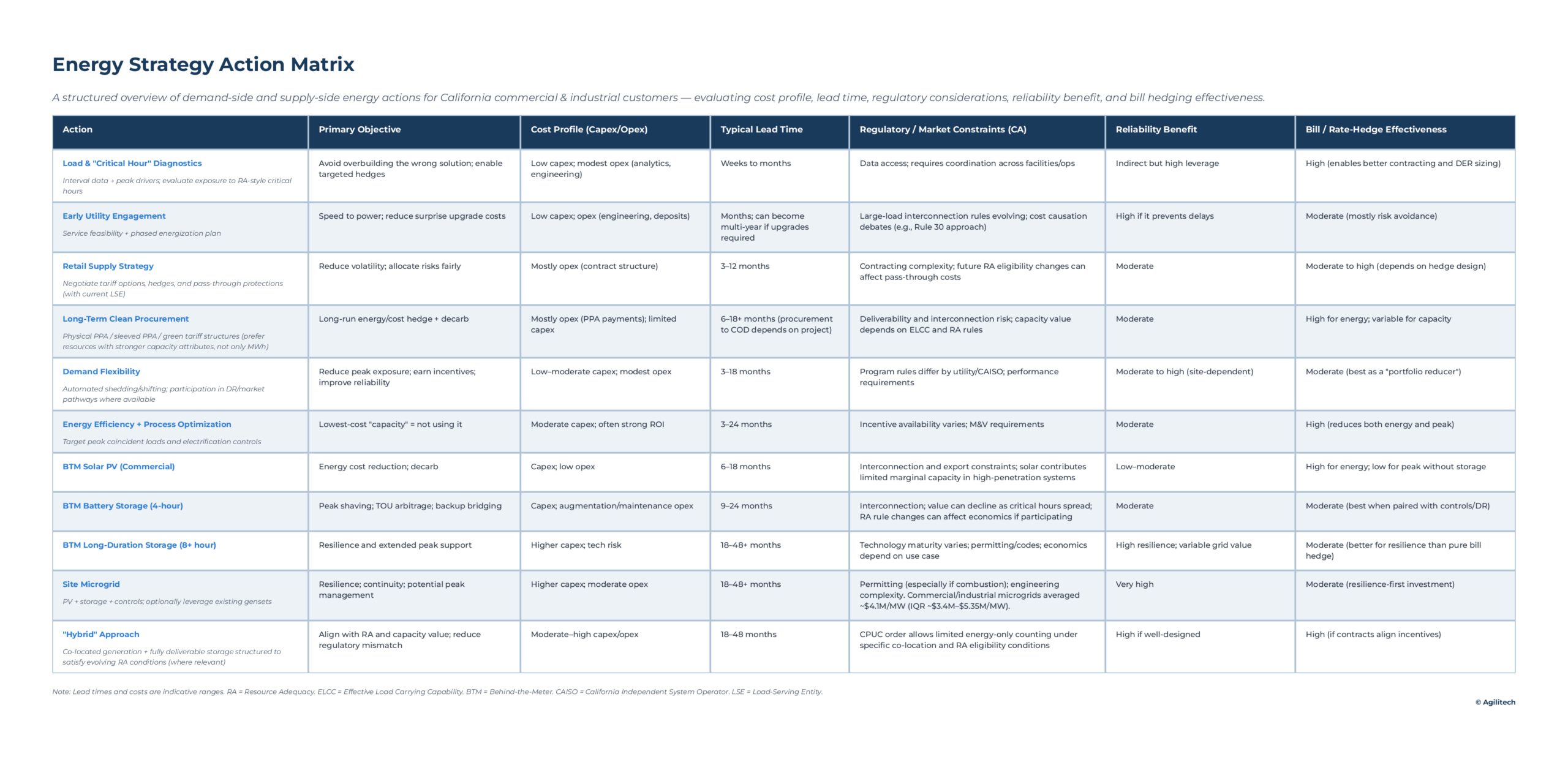
Cost anchors for executive planning (for context, not a quote for any specific project): NREL’s commercial PV benchmarks cited in the ATB report system prices around $1.99/Wdc (2022) and $1.78/Wdc (2023). [53] NREL’s utility-scale battery storage projections cite a 2022 starting point of ~$482/kWh (2022$) for a 4-hour battery system and show a wide projected range by 2030. [54] Microgrid cost varies widely by design and how much existing infrastructure can be leveraged; NREL’s microgrid dataset shows commercial projects tended to be higher-cost on a $/MW basis than some other segments. [51]
Contracting and procurement moves that map directly to the CPUC order
If you are a large-load customer (or expect to become one), the February 2026 order changes the “best practices” for California energy contracting:
Treat capacity attributes as a first-class contract term. Because the CPUC order is explicitly NQC/marginal-ELCC driven (and because marginal ELCC for some resources can remain low), contracts that only emphasize renewable MWh may not hedge the risk you actually care about: tight critical hours. [2]
Demand “deliverability realism.” The CPUC is coordinating resource portfolios with CAISO transmission planning, but transmission projects can take many years, and deliverability is still a binding system constraint. [55] Your contracts should include development milestones, deliverability / interconnection status reporting, and remedies if COD or deliverability assumptions fail.
Scenario-test your load growth case against cost allocation pathways. CAISO’s large-load paper highlights that PG&E’s Rule 30 interim approach places full initial infrastructure cost on the connecting customer while broader cost causation is evaluated. [45] This has direct implications for campus expansions, data center developments, and electrified industrial projects: “utility will build it” may still be true, but “utility will pay for it” is increasingly uncertain.
Mermaid timeline and merit-order decision path through 2032
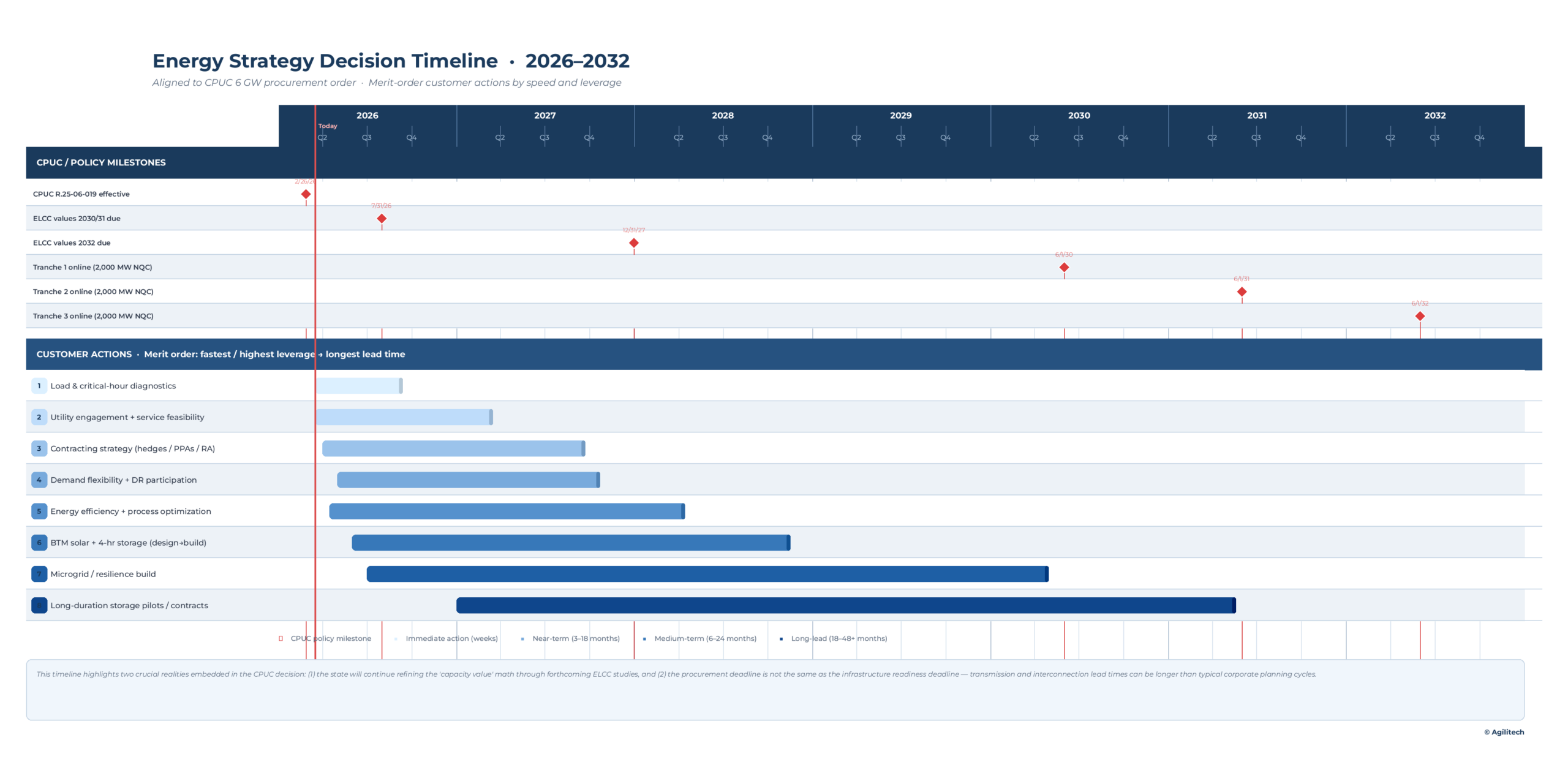
This timeline highlights two crucial realities embedded in the CPUC decision: (1) the state will continue refining the “capacity value” math through forthcoming ELCC studies, and (2) the procurement deadline is not the same as the infrastructure readiness deadline—transmission and interconnection lead times can be longer than typical corporate planning cycles. [49]
Executive-action checklist
Use this as a practical, board-ready checklist aligned to the risk envelope implied by the order.
Validate your load-growth story with engineering detail. Build a 5–10 year site-by-site forecast, then translate it into “critical hour” exposure (not just annual MWh). [56]
Quantify your “speed to power” risk. Engage the serving utility early to understand whether your project triggers distribution upgrades or transmission-level solutions—and what cost allocation regime could apply (including customer-funded initial infrastructure in some pathways). [5]
Re-contract for capacity attributes, not only renewable energy claims. Prioritize contract structures that explicitly address deliverability/interconnection milestones and that consider how RA eligibility and marginal ELCC can evolve. [57]
Build a demand flexibility layer before you build expensive steel. Demand response, automated shedding/shifting, and controls can be deployed faster than most infrastructure and can reduce the amount of capacity you must “buy.” [56]
Treat resilience as a separate investment thesis. If outage costs are material, microgrids and longer-duration onsite designs may outperform “grid-only” planning—even if they are not the lowest-cost energy option. [58]
Stress-test PCIA and cost-allocation implications of your LSE strategy. The CPUC decision’s explicit PCIA vintage treatment for IOU procurement under this order is a reminder that “who serves you” and “how costs are allocated” can matter as much as the commodity price. [59]
Endnotes and key document links
Endnotes
CPUC February 2026 decision and summary materials: the decision requires 2,000 MW NQC per year (2030–2032), defines the 25% clean-firm/LDES floor, sets 10-year contract requirements, schedules ELCC studies, and ties compliance to evolving RA eligibility. [60]
Load growth context and large-load integration: CAISO frames large loads as a planning priority, cites CEC data center growth forecasts, and documents evolving cost-allocation and service models (including Rule 30 interim customer-funded initial infrastructure). [17]
Demand forecast and drivers: CPUC materials attribute large future managed-load growth to EVs, building electrification, and data centers; the CEC’s data center forecast work describes methodology and indicates intent to support busbar-level planning. [61]
Transmission reality: CAISO’s transmission plan documents reliability-driven transmission needs tied to load growth and highlights multi-year lead times for major projects. [33]
Customer bill context: LAO documents rapid historical rate increases and identifies wildfire costs, decarbonization investments, and demand growth as key drivers. [41]
Capacity-credit fundamentals: NREL summarizes why ELCC (especially marginal ELCC) is used to quantify capacity value and why marginal capacity value of resources (notably solar) can decline with penetration. [35]
Mid-term procurement history: CPUC’s 2021 MTR order (11,500 MW NQC) and 2023 Supplemental MTR order (4,000 MW NQC) provide the direct procedural and policy precedent for the 2026 order. [62]
Key document links
CPUC Feb 26, 2026 decision (R.25-06-019):
https://docs.cpuc.ca.gov/PublishedDocs/Published/G000/M600/K398/600398976.PDF
CPUC Fact Sheet (Feb 26, 2026 decision on procurement + transmission planning):
https://www.cpuc.ca.gov/-/media/cpuc-website/divisions/energy-division/documents/integrated-resource-plan-and-long-term-procurement-plan-irp-ltpp/2024-2026-irp-cycle-events-and-materials/irp-tpp-decision-fact-sheet.pdf
CPUC news release (March 2, 2026) summarizing the decision:
https://www.cpuc.ca.gov/news-and-updates/all-news/cpuc-advances-clean-and-affordable-electricity-with-new-procurement-decision
CAISO Issue Paper: Large Load Considerations (Jan 2026):
https://www.caiso.com/documents/issue-paper-large-load-consideration-jan-20-2026.pdf
CAISO 2024–2025 Transmission Plan (Board-approved):
https://www.caiso.com/documents/iso-board-approved-2024-2025-transmission-plan.pdf
CEC 2025 IEPR Preliminary Data Center Forecast (Oct 2025):
https://www.energy.ca.gov/sites/default/files/2025-11/2025_IEPR_Preliminary_Data_Center_Forecast_ada.pdf
LAO report on California residential electricity rates (Jan 2025):
https://lao.ca.gov/reports/2025/4950/Residential-Electricity-Rates-010725.pdf
Industry coverage (PV Magazine USA; Utility Dive):
https://pv-magazine-usa.com/2026/03/17/seeing-shortage-california-seeks-6-gw-clean-power-capacity/
https://www.utilitydive.com/news/cpuc-california-lses-procure-6-gw-2032/813357/
[1] [7] [34] https://www.cpuc.ca.gov/news-and-updates/all-news/cpuc-advances-clean-and-affordable-electricity-with-new-procurement-decision
[2] [3] [11] [12] [13] [14] [16] [18] [19] [20] [22] [23] [29] [39] [43] [46] [47] [49] [52] [55] [57] [59] [60] https://docs.cpuc.ca.gov/PublishedDocs/Published/G000/M600/K398/600398976.PDF
https://docs.cpuc.ca.gov/PublishedDocs/Published/G000/M600/K398/600398976.PDF
[4] [8] [9] [10] [15] [24] [26] [40] https://www.cpuc.ca.gov/-/media/cpuc-website/divisions/energy-division/documents/integrated-resource-plan-and-long-term-procurement-plan-irp-ltpp/2024-2026-irp-cycle-events-and-materials/irp-tpp-decision-fact-sheet.pdf
[5] [17] [31] [45] https://www.caiso.com/documents/issue-paper-large-load-consideration-jan-20-2026.pdf
https://www.caiso.com/documents/issue-paper-large-load-consideration-jan-20-2026.pdf
[6] [33] [44] https://www.caiso.com/documents/iso-board-approved-2024-2025-transmission-plan.pdf
https://www.caiso.com/documents/iso-board-approved-2024-2025-transmission-plan.pdf
[21] [27] [62] https://www.cpuc.ca.gov/-/media/cpuc-website/divisions/energy-division/documents/integrated-resource-plan-and-long-term-procurement-plan-irp-ltpp/d2106035-mtr-decision-factsheet–07-01-2021.pdf
[25] https://www.energy.ca.gov/sites/default/files/2023-01/MOU_Dec_2022_CPUC_CEC_ISO_signed_ada.pdf
https://www.energy.ca.gov/sites/default/files/2023-01/MOU_Dec_2022_CPUC_CEC_ISO_signed_ada.pdf
[28] [48] https://docs.cpuc.ca.gov/PublishedDocs/Published/G000/M502/K956/502956567.PDF
https://docs.cpuc.ca.gov/PublishedDocs/Published/G000/M502/K956/502956567.PDF
[30] [61] https://www.cpuc.ca.gov/-/media/cpuc-website/divisions/energy-division/documents/integrated-resource-plan-and-long-term-procurement-plan-irp-ltpp/2024-2026-irp-cycle-events-and-materials/assumptions-for-the-2026-2027-tpp/26-27-tpp-pd-resolve-and-servm-analysis.pdf
[32] https://www.energy.ca.gov/sites/default/files/2025-11/2025_IEPR_Preliminary_Data_Center_Forecast_ada.pdf
[35] [37] Average and Marginal Capacity Credit Values of Renewable Energy and Battery Storage in the United States Power System
https://docs.nrel.gov/docs/fy25osti/89587.pdf
[36] [38] [50] [56] RCPPP Scope Considerations
[41] [42] https://lao.ca.gov/reports/2025/4950/Residential-Electricity-Rates-010725.pdf
https://lao.ca.gov/reports/2025/4950/Residential-Electricity-Rates-010725.pdf
[51] [58] https://docs.nrel.gov/docs/fy19osti/67821.pdf
https://docs.nrel.gov/docs/fy19osti/67821.pdf
[53] https://atb.nrel.gov/electricity/2024/commercial_pv
https://atb.nrel.gov/electricity/2024/commercial_pv
[54] https://docs.nrel.gov/docs/fy23osti/85332.pdf
Talk To Us