One Decision. Twenty Years of a Different Energy Story.
What California commercial and industrial operators need to know about solar + storage ROI — and why the 2026 ITC deadline changes the math.
There is a number we keep coming back to.
$25 million.
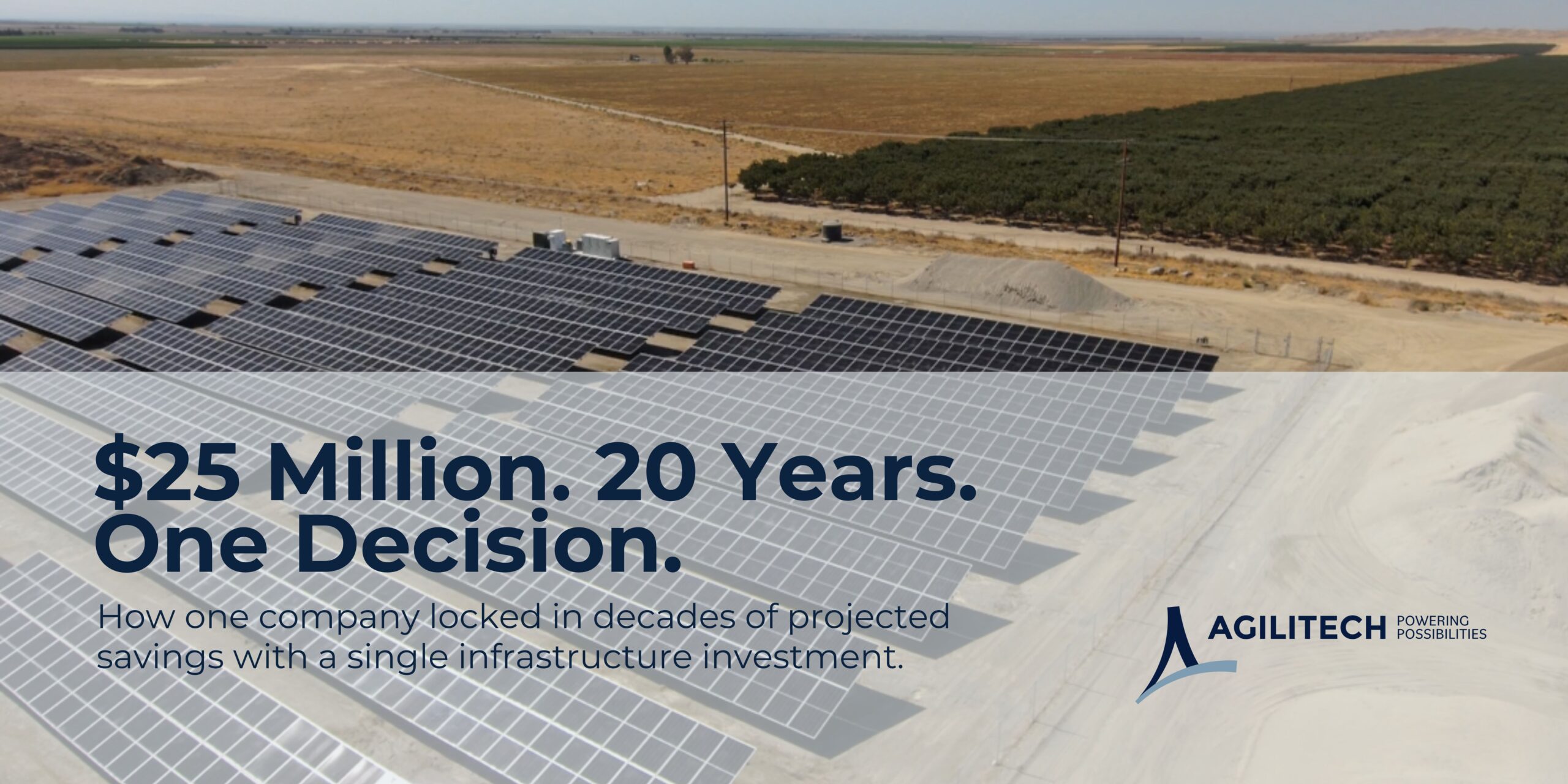
That is what one client’s Agilitech solar + storage system is projected to save over the next 20 years — while stabilizing operations against the peak demand charges that were quietly compressing margins every single month.
When they came to us, the conversation started the way it does for most of the operators we work with. Energy costs were rising. Demand charges were unpredictable. The grid was not a reliable partner. And somewhere in every budget meeting, there was a line item that kept growing and offered nothing in return.
What changed was not the problem. What changed was the decision to engineer their way out of it.
That decision — and the financial reality behind it — is what we want to walk through here. Because for commercial and industrial operators in California right now, it is one of the most consequential infrastructure choices available. And the window to capture maximum incentives is closing.
Why Are California Energy Costs Getting Harder to Manage?
California’s commercial and industrial energy environment has become structurally hostile to passive management. Three forces are converging in a way that makes the status quo increasingly expensive:
- Demand charges that can double a monthly bill from a single peak usage event — regardless of how efficiently a facility operates the other 29 days of the month.
- Time-of-use pricing that ensures the hours your facility depends on power most are the hours you pay the highest rates for it.
- Grid instability — PSPS events, outages, and weather-related disruptions that are not inconveniences for industrial operators. They are production losses, spoilage risks, and business continuity failures.
The operators who are moving fastest are not the ones who care most about sustainability. They are the ones who have looked at their energy bills and decided that continuing to absorb annual rate increases — with no return on that capital — is no longer an acceptable business strategy.
Solar and battery storage, designed and built as critical infrastructure rather than an environmental add-on, is the answer to all three problems at once.
What Does the Financial ROI on Commercial Solar Actually Look Like?
The reason capex approval for well-engineered solar + storage systems tends to be swift is that the financial modeling is difficult to argue with. These are the results Agilitech clients are actually achieving — modeled conservatively, stress-tested against rate changes and policy scenarios, and grounded in real energy profiles rather than optimistic assumptions.
47%
Avg. annual energy cost reduction
3.5 yrs
Typical full ROI payback
$4.5M
Avg. lifetime savings per facility
500%
Avg. 20-year ROI
Top-performing projects have delivered payback in 1.3 years, lifetime savings exceeding $15 million, and internal rates of return above 60%. Even the most conservative models — built for facilities where conditions are less favorable — still deliver 33% annual savings and more than $430,000 in 20-year lifetime value.
The pattern that emerges across these projects is consistent: the economics are strong enough that, when modeled correctly, the decision becomes straightforward. As one plant manager put it after their system was completed:
Getting the capex approved was instant. Because of how strong the economics were. It was a no-brainer.
— Plant Manager, Agilitech Client
Is Solar Alone Enough for Commercial and Industrial Facilities in 2026?
One of the most important shifts we documented in our 2026 microgrid report — Microgrids After 2025: How Solar and Battery Storage Are Reshaping Business Energy Strategy in 2026 — is this: solar alone is no longer the complete solution for C&I facilities.
The combination of solar generation, battery storage, smart controls, and microgrid design is becoming standard practice for industrial operators who need more than energy cost reduction. They need operational resilience.
What that means in practice:
- Peak shaving that eliminates demand charge spikes by dispatching stored energy at precisely the right moment.
- Backup power that protects refrigeration, pumps, and mission-critical applications during outages and PSPS events.
- Load optimization that intelligently shifts consumption away from the most expensive time-of-use windows.
- Modular scalability — systems designed today can expand as load grows, EV charging is added, or electrification targets change.
The facilities that are capturing the most value from these investments are the ones that approached solar + storage as infrastructure — engineered from the ground up for their specific operational profile — rather than as a commodity purchase.
FROM OUR 2026 MICROGRID REPORT
The real differentiator in 2026 will be how well systems are designed, integrated, and supported across their lifecycle — particularly for commercial facilities and industrial microgrids where operational continuity matters.
What’s the Difference Between a Solar Installer and a Full EPC Firm?
There is a meaningful distinction between a solar installer and a full EPC firm — Engineering, Procurement, and Construction — and it becomes visible at every stage of a project that has any complexity to it.
An installer delivers equipment. An EPC firm engineers a system. The difference shows up in how accurately the financial projections hold. It shows up in how the system performs when utility rates change or when a grid event tests the battery storage. It shows up in whether someone picks up the phone in year seven when a component needs attention.
Agilitech has been delivering critical infrastructure projects for over 20 years — across renewable energy, water and wastewater, food and beverage, manufacturing, mining, and oil and gas. Our solar + storage practice brings that same EPC discipline to the commercial and industrial solar market: custom engineering, Tier-1 equipment, utility interconnect management, a 10-year workmanship warranty, and long-term monitoring programs.
We also shoulder the complexity that keeps most facilities from moving forward — permitting, utility coordination, construction scheduling around active operations. The goal is that our clients stay focused on running their businesses while we handle the process that most installers hand back to the owner.
What Is the 2026 ITC Deadline — and How Does It Affect My Project?
The 30% federal Investment Tax Credit remains available — and it is the single most powerful financial lever in the commercial solar decision. For a $1.5 million system, that is $450,000 back to the business. For a $3 million system, it is $900,000.
But recent IRS updates have narrowed how projects qualify. To capture the full 30% credit:
- Construction must generally begin by July 4, 2026.
- Systems must be placed in service by December 31, 2027 for most installations.
- The previous 5% safe harbor provision has been restricted after September 2, 2025.
What this means practically: the projects that capture maximum incentives are the ones where scoping, engineering, and permitting are already underway. Most commercial and industrial solar + storage projects run on a 9–15 month timeline from Notice-to-Proceed to commissioning. The math on timing is straightforward.
THE ITC WINDOW IN PLAIN TERMS
Projects that begin the assessment and engineering process now are on track. Projects that wait until Q3 or Q4 of 2026 are likely to miss the full 30% ITC — and with it, a six-figure to seven-figure difference in the return on investment.
Which Facilities Are the Right Fit for Commercial Solar + Storage?
Not every facility is the right fit for commercial solar + storage. We will tell you that upfront — it is part of how we operate. But for the operators where the economics work, they tend to work compellingly. The profile looks like this:
- Commercial and industrial facilities in California with meaningful monthly utility bills — manufacturing, food and beverage, agriculture, construction materials, mining, commercial real estate.
- Operations where energy is not just a cost but an operational dependency — where a grid event has real production consequences.
- Businesses with a horizon of at least 5–10 years at their current facility, where the long-term savings picture is relevant to capital planning.
- Owners and operators who are tired of a utility bill that has no ceiling and offers no return on the capital it consumes.
If that description fits your facility, the free Energy Savings Assessment is the right next step. It is a data-driven analysis of your specific energy profile — your usage, your utility rates, your available incentives, and your financial objectives — delivered by EPC engineers who will tell you honestly whether the numbers make sense for your situation.
Ready to see what your facility could save?
Request your free Energy Savings Assessment at agilitechgroup.com/solar. One of our EPC experts will connect with you within 48 hours — no obligation, no pressure, just the numbers specific to your facility.
Or contact us directly at info@agilitechgroup.com or 661.381.7800.
FURTHER READING
For a deeper look at where business energy strategy is heading in 2026 — including the five shifts we’re seeing on the ground with C&I operators across California — read our full report: Microgrids After 2025: How Solar and Battery Storage Are Reshaping Business Energy Strategy in 2026. Available free at agilitechgroup.com.
About Agilitech
Agilitech is a licensed EPC firm — Engineering, Procurement, and Construction — with over 20 years of experience delivering critical infrastructure across renewable energy, water and wastewater, food and beverage, manufacturing, mining, and commercial sectors. Our solar + storage systems are custom-engineered for commercial and industrial facilities, backed by Tier-1 equipment, long-term monitoring, and a 10-year workmanship warranty. Headquartered in Bakersfield, California.
agilitechgroup.com